


Coaxial Shunt Selection Guide
Source: Probemart 2025-01-08 Views: 515
To help more users correctly choose the model applicable to them, today, regarding how to select this coaxial shunt,
we provide a clear explanation of the approach, hoping to offer some reference.
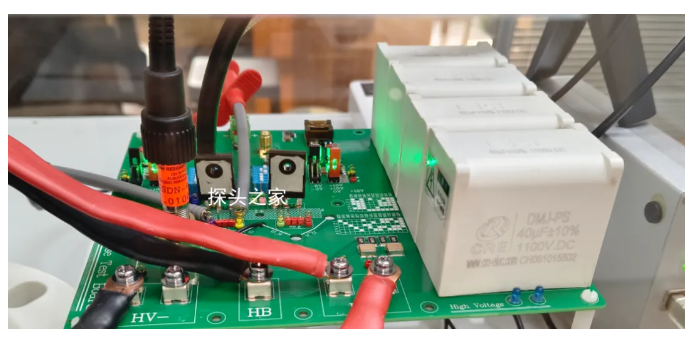
In essence, a coaxial shunt is a very small resistor that converts the current signal passing through it into a voltage signal,
It is generally used to measure large pulsed currents. In different measurement scenarios, a suitable coaxial shunt must be selected.
Selection mainly considers the following aspects:
1. Power dissipation
One of the most important parameters in selection is Joule heating; the heat generation of the coaxial shunt must not exceed its maximum tolerable Joule heating. The Joule heating calculation formula is:
Q=I²*R*t
【Joule = current squared * resistance * pulse width time″】
Here, the current must be calculated using the highest peak value,For a double pulse, the high-level duration of the 2 pulses must be included; for multiple pulses, the high-level duration of all pulses must be included.
In general, selection should reserve a margin of 1/2 to 1/3 for Joule heating. It can also be seen from the formula that the larger the time t, the larger the Joule heating Q,
Therefore, coaxial shunts are mainly used to measure pulsed currents.
It is worth noting here thatexceeding the Joule heating may burn out the coaxial shunt.。
If the common SDN series cannot meet the Joule heating requirement, the medium-power M series or A series can be considered, with Joule heating ratings from tens to more than 2,000 J.

The figure shows an actual photo of the medium-power M series.
2. Resistance value
The resistance value is related to the signal strength and the influence of insertion into the circuit.
The smaller the resistance value, the smaller the influence of insertion into the circuit; the larger the resistance value, the stronger the voltage signal received by the oscilloscope.。
When measuring SiC current (generally 500A to 2000A), in most cases a coaxial shunt is used to measure the current,
Here, the shunt model must be selected according to the magnitude of the current under test; for such high-current measurements, models with relatively low resistance are generally selected,
such as SSDN-414-01.
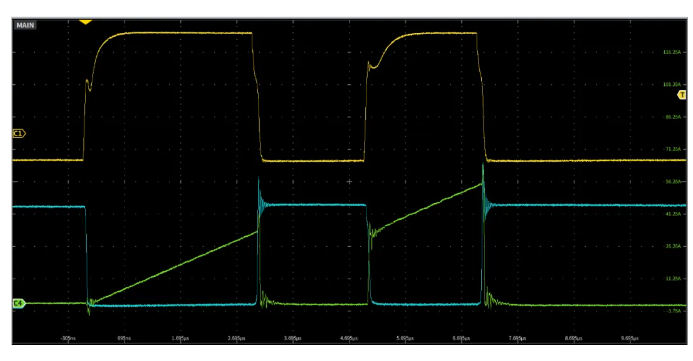
Coaxial shunt & double-pulse testing waveform diagram
When measuring GaN current (generally not exceeding 100A), a model with slightly larger internal resistance can be selected to ensure measurement accuracy,
Example: when the selected model has an internal resistance of about 0.01Ω, then for a measured current of 50A, U=I*R=0.5V can still be displayed on the oscilloscope;
If the measured current is 1A or even smaller, a model with slightly larger resistance must be selected, for example a model with 0.1Ω resistance, to ensure the accuracy of the reading.
This selection is to ensure that the waveform signal displayed by the oscilloscope is sufficiently faithful, because the oscilloscope can capture very small signals but is greatly affected by the noise floor,
which will cause signal distortion and make the measurement data invalid.
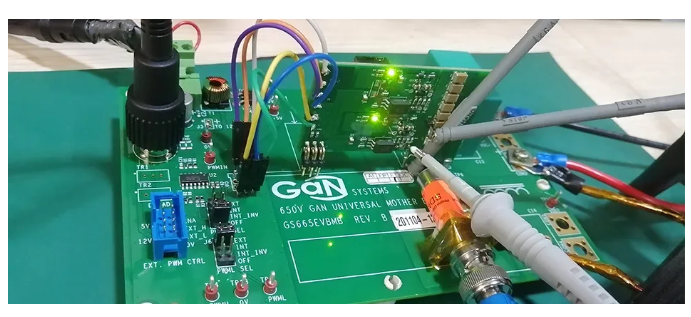
As for why an ordinary resistor is not used for direct measurement in the latter case, it is because direct measurement with an ordinary resistor makes it difficult to ensure measurement accuracy,
and it is easily disturbed by various factors, which is unacceptable for high-precision measurement requirements.
Since a model with slightly larger resistance measures small currents accurately, would it not be even more accurate for large currents? This is not the case; when we use a shunt to measure current, it is essentially
connected in series with the on-resistance in the circuit. If a high-resistance model is also used for large-current measurement, according to the formula, this will increase the overall resistance,
This will also increase measurement interference and affect measurement accuracy.
3. Bandwidth
The selection of bandwidth is quite straightforward: if the above two points are met,the higher the bandwidth, the better。
The following are commonly used coaxial shunt models:
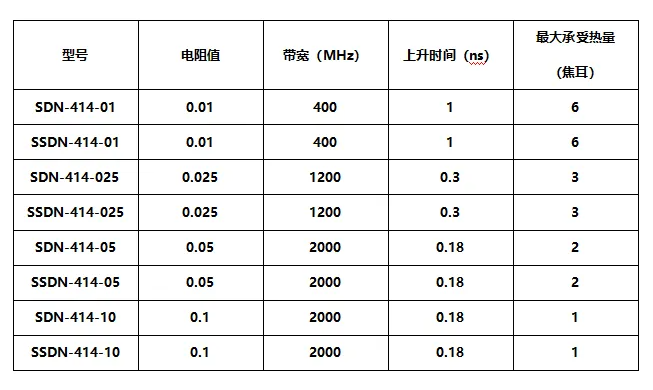
4. Isolation
A coaxial shunt is a pure-resistance structure; its greatest advantage is high bandwidth and non-inductive (approaching), and it is only slightly affected when measuring high-frequency current,
This makes it well suited for high-frequency current measurement, such as double-pulse dynamic testing of SiC/GaN wide-bandgap power devices.
The disadvantage of the coaxial shunt is that it provides no isolation; the oscilloscope and the circuit under test must share a common ground.
Therefore it is generallyused only to measure non-floating currents and cannot directly measure floating currents。
To avoid this drawback, we recommend a solution that combines a coaxial shunt with a PMK optically isolated probe to achieve isolation,
as shown in the figure below
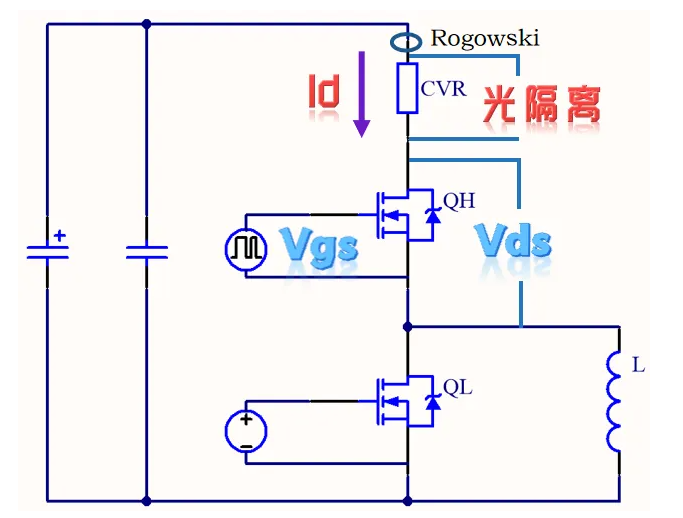
If you have any other questions about coaxial shunts, please contact us directly.
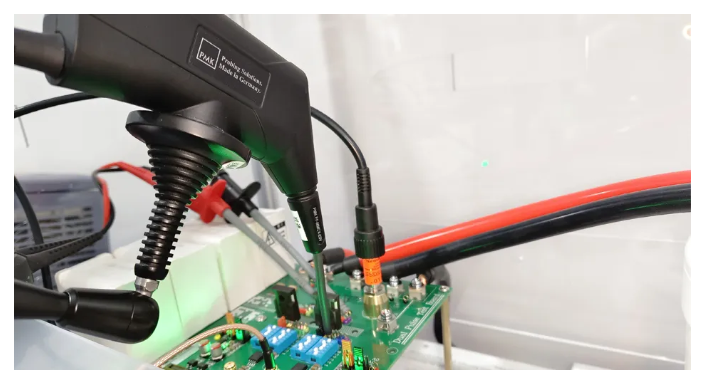
The figure shows a dynamic test system with a T&M coaxial shunt paired with a PMK optically isolated probe.

PCIM Europe 2026, Nuremberg: IWATSU and PMK at Booth H7-157
2026-06-15
APEC 2026: 41st IEEE Applied Power Electronics Conference and Exposition
2026-03-15
Semicon China 2026, Shanghai New International Expo Centre (SNIEC)
2026-03-11
WiPDA Asia 2025, Beijing International Convention Center, 15 August
2025-08-06