


Low-Voltage Differential Probes
Source: Probemart 2024-12-30 Views: 378
In testing and measurement, various test probes are often used, and there are many types to handle different test environments. Choosing the right probe has become a common headache for engineers. This article will recommend selecting low-voltage differential probes by comparing two brands
First, what is a differential probe? In some specific tests, floating measurements are required, and probes that isolate measurements to handle this environment are called differential probes. Differential probes are divided into low-voltage and high-voltage differential probes
Low-voltage differential probes mainly measure low-voltage differential signals, which are common in high-speed digital circuits, typically with bandwidths above 1GHz and relatively low voltage, with amplitudes of ±8V; High-voltage differential probes measure high-voltage differential signals with voltages up to above kV, and such signals are common in switching power supply measurements. Differential signals are mutually referenced, not ground as the reference point. Ordinary single-ended probes can also measure differential signals, but the resulting signal differs greatly from the actual signal and may cause a "ground bounce" phenomenon
Differential probes can not only measure differential signals but also single-ended signals. Moreover, differential probes have the following advantages when measuring single-ended signals: increasing higher input impedance to reduce load effects on the circuit under test; effectively suppressing common-mode noise and improving signal-to-noise ratio; avoiding ground loops or ground collisions to prevent interference with measurement results; flexibly selecting test points without being restricted by oscilloscope grounding
This article mainly recommends and selects low-voltage differential probes. Low-voltage differential probes have many applications in measurement, such as design, verification, debugging, and verification of common high-speed serial buses; signal integrity, jitter, and timing analysis; manufacturing engineering and testing; disk drive read channel design etc
The main recommended brands in this article are Tekk (USA) and PMK (Germany), both of which are relatively outstanding brands in the industry
Tekspan style="font-size: 16px; font-family: isoline;"> low-voltage differential probes include the TDP series and the P6000 series. The parameter table for Tektek's TDP series low-voltage differential probes is as follows:
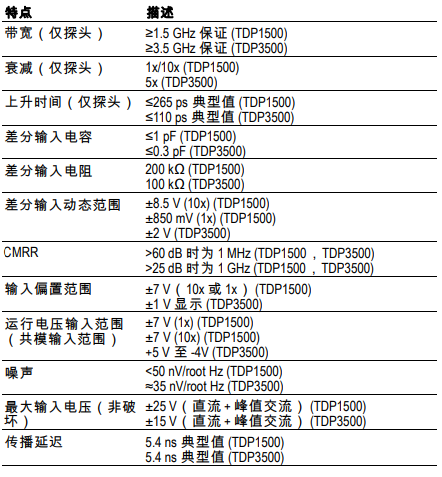
The probe parameters of the P6000 series are as follows:


The parameters of PMK's HSDP series probes are as follows:


After comparing the parameters of both, it was found that each has its own advantages and disadvantages, so a comparison table was created based on their parameters, as follows:
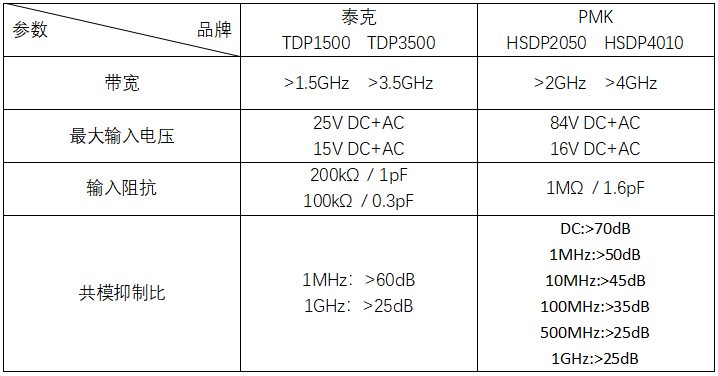
From this comparison chart, we find that PMK has advantages in maximum input voltage and bandwidth, while common-mode rejection is clearer than the parameters. but HSDPThe series at the common-mode rejection ratio on 1MHz lags behind Tektek's low-voltage differential ratio. In addition, PMK's HSDP series is completely superior in performance to Downtek's TDP low-voltage differential series

The Tektronix P6000 series low-voltage differential probe achieves about 10% higher common-mode rejection at 1x attenuation compared to the HSDP series, but at 10x attenuation, the common-mode rejection ratio is only about 10% lower. PMK has a higher HSDP2050 bandwidth and a much higher maximum input voltage, but the HSDP series does not have specific DC accuracy parameters, only noise parameters
The HSDP series has a minimum bandwidth of 1.8GHz and a maximum of 4GHz; Tek's low-voltage differential probes range from 400MHz to 3.5GHz, with Tek's low-voltage differential range offering a wider range of bandwidths. The Tektronix P6000 series also offers two attenuation ratios to choose from, while HSDP does not have multiple attenuation ratios to choose from. The HSDP series offers wider bandwidth at the same level, measures a wider voltage range, has higher input resistance, and smaller input capacitance
In summary, both brands have their pros and cons, but Tek's low-voltage differential requires TekVPI socket oscilloscopes for power supply, which leads to compatibility issues with other brands. HSDP does not have this problem but requires a matching power supply for better compatibility

If there are other issues during the selection, you can consult us directly for technical advice

PCIM Europe 2026, Nuremberg: IWATSU and PMK at Booth H7-157
2026-06-15
APEC 2026: 41st IEEE Applied Power Electronics Conference and Exposition
2026-03-15
Semicon China 2026, Shanghai New International Expo Centre (SNIEC)
2026-03-11
WiPDA Asia 2025, Beijing International Convention Center, 15 August
2025-08-06