


Rogowski Coils vs. Other Current Probes: Strengths and Weaknesses
Source: Probemart 2025-01-07 Views: 2020
Rogowski coils vs. other current probes: advantages and disadvantages
In current measurement, multiple types of current probes are available for different application environments; by function, they are mainly divided into
two major categories: AC current and DC current.
DC current probes mainly include AC/DC probes, primarily fluxgate and Hall-effect current probes, etc. AC current probes mainly include Hall-effect current probes (AC/DC),
Rogowski coils, coaxial CVRs (pulse), pulsed current transformers (CTs), etc.

The Rogowski Coil, also called a Rogowski coil, Rogowski coil, or air-core coil, is an electronic transformer used to measure AC current
such as high-speed transients, pulsed currents of power devices, or 50 Hz AC or high-frequency AC signals.
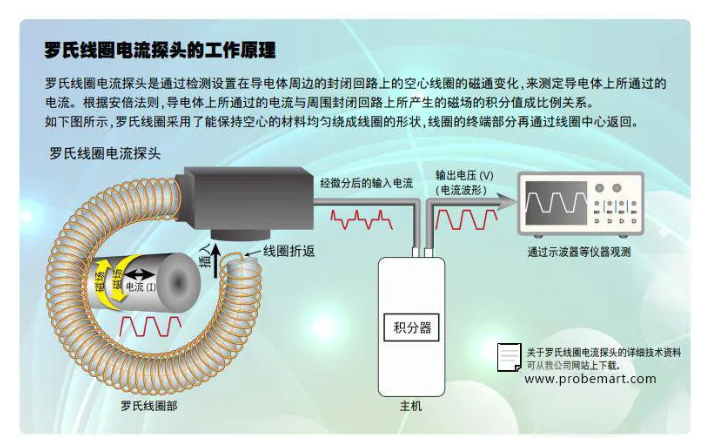
1. Advantages of using Rogowski coils
Rogowski coil current probes have many advantages over various types of current sensors or sensing technologies.
-No magnetic saturation in high-current testing
Rogowski coils can measure large currents without magnetic-core saturation because the probe uses a non-magnetic “air” core. In contrast, Hall-effect current probes,
pulsed current transformers, and other sensors containing magnetic cores undergo magnetic saturation when the measured current exceeds the maximum range, causing direct damage to the probe.
For example, when using a CT pulsed current probe to measure capacitor discharge, if the discharge time is too long and exceeds the maximum ampere-second product specified by the probe ratings,
there is also a risk of causing magnetic saturation of the probe, whereas using a Rogowski coil eliminates this concern.
-Flexible usage
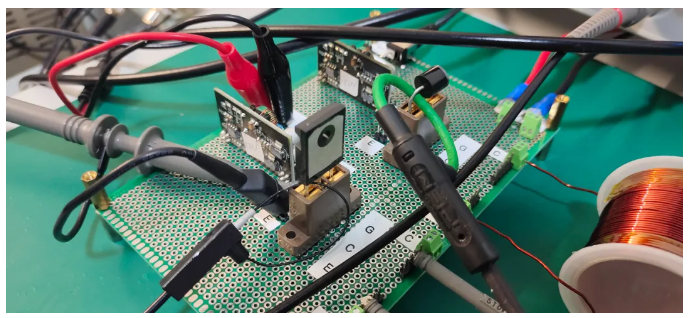
The lightweight clamp-on sensing coil is flexible in use and has an open-loop design, so it can easily wrap around a current-carrying conductor. It can be inserted into hard-to-reach components within a circuit.
The designs of other current probes cannot achieve the same lightness and flexibility as Rogowski coils.
A thick Rogowski coil can have a circumference of up to 1100 mm and can measure equipment or cables with a diameter exceeding 30 cm,Most Rogowski coils are thin enough
to fit between the legs of TO-220 or TO-247 power semiconductor packages without an additional coil to connect to the current probe. This also provides the advantage of achieving high-signal-integrity measurements.
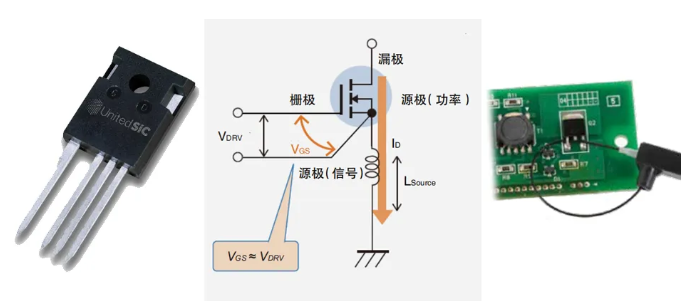
IWATSU Rogowski coil SS-660/P series has a minimum wire diameter of 1 mm
-Non-invasive or non-destructive measurement
Due to low insertion impedance, the Rogowski coil draws very little current from the device under test, and its effect on the circuit under test is almost negligible.
Compared with probes such as shunts that are connected into the circuit, the Rogowski coil has less effect on the circuit under test.
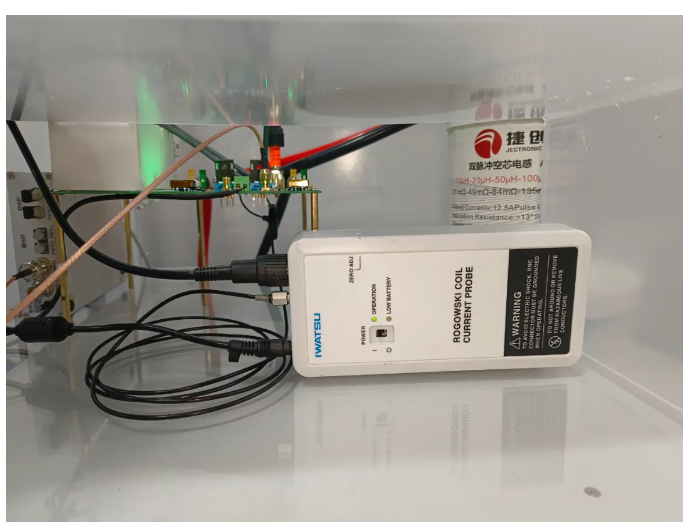
Because the impedance injected into the device under test by the probe is very small, it supports faster signal response and a highly linearized signal voltage.
-Wide measurement range
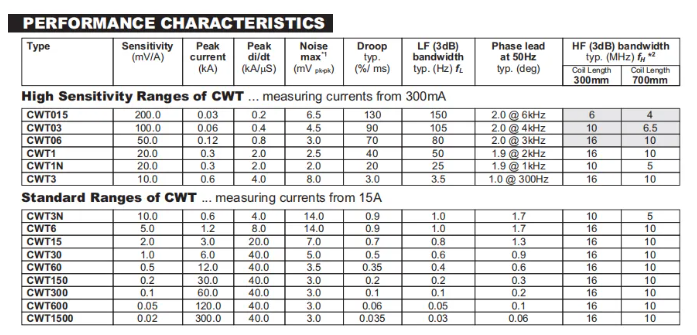
Rogowski coils can measure a range from 30 A to 30 kA, provide good accuracy for both large and small current measurements, and are available in multiple ranges,
to handle various measurement environments.
Unlike other current sensors that become bulkier as the measured current range increases, Rogowski coils, being independent of the measured current amplitude,
can thus maintain the same small size. This makes the Rogowski coil the most effective measurement tool for measuring large AC currents of hundreds or even thousands of amperes.
-Good temperature characteristics
The front-end coil of the Rogowski coil can perform measurements at temperatures from -40°C to 125°C and has good temperature characteristics, especially IWATSU's Rogowski coils
SS-280A-H series, with a maximum test temperature of up to 150°C, which other current probes cannot reach.

- Low cost
Compared with Hall-effect current sensors and pulsed current transformers, Rogowski coils are relatively less expensive.
II. Usage limitations of Rogowski coils
Of course, Rogowski coils also have some usage limitations and cannot handle all current measurement environments.
-Not suitable for DC current measurement
Most Rogowski coils are made based on the principle of electromagnetic induction; they cannot measure constant DC current and are limited to AC measurement.
Hall-effect current probes, however, measure based on the principle of the Hall effect; as long as the current produces a magnetic field, the current can be measured based on this.
A Rogowski coil measures current based on the induced electromotive force generated by the changing magnetic field that varies with the current;
whereas a Hall-effect current probe measures current based on the Hall voltage generated in a magnetic field by a current-carrying Hall element,
Therefore, a Rogowski coil can measure only AC, whereas a Hall-effect probe can measure both AC and DC.

PEM's DCflex series is one of the few Rogowski coils capable of measuring DC (10KA~40KA)
-Relatively low sensitivity
Compared with a current transformer, a Rogowski coil has lower sensitivity, which is due to the Rogowski coil's lack of a high-permeability magnetic core.
Both test accuracy and stability during testing are reflected through sensitivity; for a probe, the higher the sensitivity, the better.
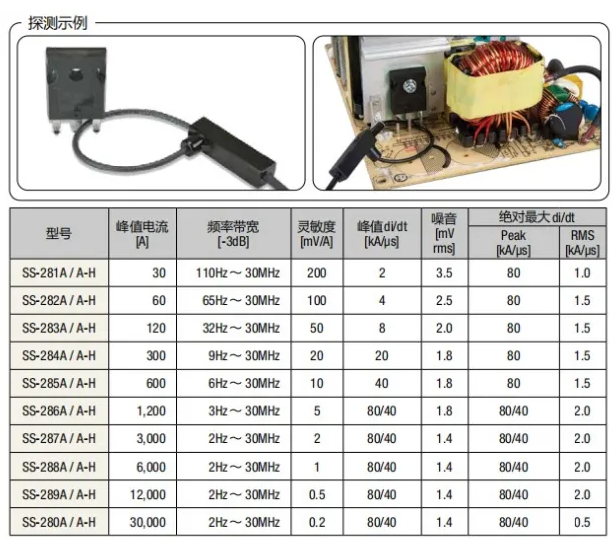
Rogowski coils generally have a maximum sensitivity of 200 mV/A
-Relatively low bandwidth
The bandwidth of a Rogowski coil is relatively low compared with that of a Hall-effect current transformer and a non-inductive coaxial shunt CVR; a conventional open-loop type reaches 30 MHz,
However, such bandwidth can also enable a Rogowski coil to measure current signals that change extremely rapidly. It also allows analysis, in systems operating at high switching frequencies, of
higher-order harmonics, or precise monitoring of switching waveforms with fast rise or fall times. Achieving high-signal-integrity measurement.
(Hall-effect current probes have a maximum bandwidth of 120 MHz, while shunts or current sensors can have bandwidths up to GHz).
It is hoped that the above summary of several points comparing the advantages and disadvantages of Rogowski coils with other current probes can serve as a reference for engineers when selecting probes,
For more probe selection information, please visit the Probemart official website www.probemart.com

PCIM Europe 2026, Nuremberg: IWATSU and PMK at Booth H7-157
2026-06-15
APEC 2026: 41st IEEE Applied Power Electronics Conference and Exposition
2026-03-15
Semicon China 2026, Shanghai New International Expo Centre (SNIEC)
2026-03-11
WiPDA Asia 2025, Beijing International Convention Center, 15 August
2025-08-06