


PPM-Level Current Accuracy with Fluxgate Sensors
Source: Probemart 2025-01-08 Views: 2152
What is a fluxgate sensor?
A fluxgate sensor uses the nonlinear relationship between magnetic flux density and magnetic field strength in a high-permeability magnetic core in the magnetic field being measured under saturated excitation by an alternating magnetic field to measure weak magnetic fields.
This physical phenomenon acts as a "gate" with respect to the measured ambient magnetic field; through this "gate," the corresponding magnetic flux is modulated and an induced electromotive force is generated.
This phenomenon is used to measure the magnetic field generated by a current, thereby indirectly measuring the current.
A fluxgate sensor is based on the nonlinear magnetization characteristics of core material. Its sensing element is a core made of high-permeability, easily saturable material, with two windings around the core:
One is the excitation coil and the other is the signal coil. Under magnetization by the alternating excitation signal fl, the permeability characteristics of the core undergo periodic saturation and non-saturation changes,
so that the induction coil wound around the core induces a signal reflecting the external magnetic field.

Standard fluxgate principle
The essence of the fluxgate principle is that, under the excitation current, the inductance of an easily saturable magnetic core changes with the magnitude of the excitation current, and the change in inductance causes a change in magnetic flux,
The magnetic flux is opened or closed like a gate, so it is figuratively referred to as a fluxgate current probe (Flux Gate).
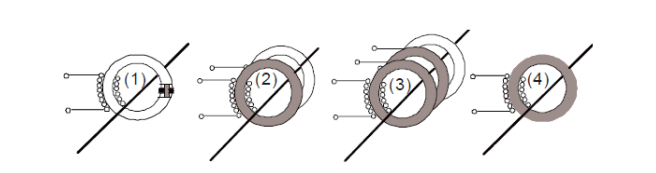
Fluxgate current probes can be further divided into several types, as shown in the figure below: for example, standard type, C-type, IT-type, low-frequency type, etc.,
The principle of the basic standard fluxgate is introduced here.
The structure of a standard fluxgate current probe is very similar to that of a closed-loop Hall structure, as shown in the figure below, except that what is placed in the air gap of the magnetic core is not a Hall element,
but a fluxgate sensor, similar to a saturable inductor.
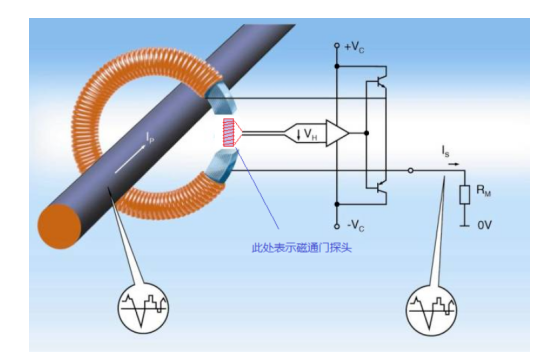
Structurally, there is likewise a primary current to be measured Ip (current in the busbar) and a secondary feedback current Is (in the secondary coil); when the total magnetic flux in the air gap of the core is 0,
Ip can be calculated from the following equation:
Ip=Ns﹒Is Ns is the number of turns of the secondary winding
We now know the method for calculating current Ip, namely, by adjusting the secondary current Is so that the total magnetic flux at the air gap is 0, Ip can be obtained;
Then, how do we detect the magnetic flux at the air gap?

Here, a fluxgate sensor is used at the air gap to detect the magnetic flux at the air gap; it consists of a magnetic core made of high-permeability, easily saturable material and a coil.
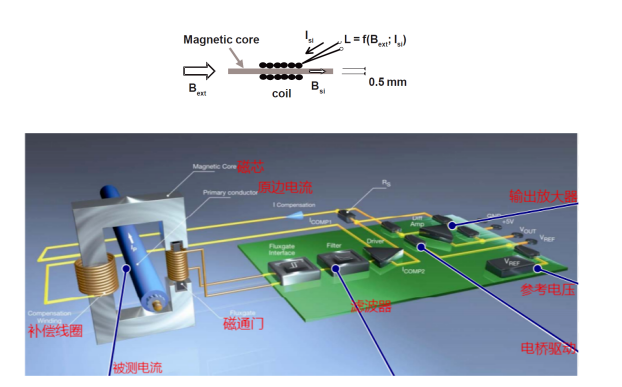
Omitting some theoretical analysis in between, when the measured current Ip=0, the complete excitation voltage Us signal in the magnetic core, as well as the excitation current Is in the coil,
See the blue waveform in the upper right part of the figure below.
When the measured current Ip≠0, the excitation current Is and the external current Ip act on the magnetic core simultaneously; its saturation occurs earlier, the inductance decreases earlier, or the current waveform is no longer symmetrical,
Even-order harmonic currents are generated. See the blue waveform in the lower right part of the figure below.

The degree of asymmetry depends on the magnitude of the measured current Ip; by processing the waveform of current Is, we can obtain a voltage or current signal proportional to the Ip current,
This completes the measurement of current Ip; this is the principle of the fluxgate current sensor.
Due to the ultra-high magnetic sensitivity unique to fluxgate, current sensors based on the fluxgate principle also have unique characteristics:
High sensitivity; measurement accuracy is much higher than that of the ordinary Hall principle, and because the fluxgate probe is based on magnetic materials, it has temperature characteristics far more stable than those of the Hall principle.
Compared with conventional open-loop Hall technology, fluxgate technology offers advantages such as fast response time, high accuracy, high linearity, high bandwidth, and low temperature drift.

Related technical parameters of the fluxgate
Considering the performance indicators of the fluxgate sensor, general static performance indicators include linearity, repeatability, hysteresis, sensitivity, bandwidth, resolution, zero-point and sensitivity temperature drift, etc.
The following briefly introduces some performance indicators of the sensor.
Bandwidth: the frequency passband range of the fluxgate frequency characteristic to -3 dB.
Primary rated current Ipn: the DC rated value or AC RMS value of the current to be measured.
Accuracy/accuracy XG: the degree of deviation of the measurement from the true value.
Linearity: The extent to which the actual measured input-output calibration curve of the sensor does not agree with a specified (theoretical) straight line is called the sensor's nonlinearity error, or linearity.
Sensitivity/current transformation ratio Kn: the ratio of the change in the sensor output quantity to the change in the input quantity;
Zero-point temperature drift: the change in the sensor zero point caused by a unit temperature change, expressed as a percentage of the sensor's full-scale output at the initial temperature.
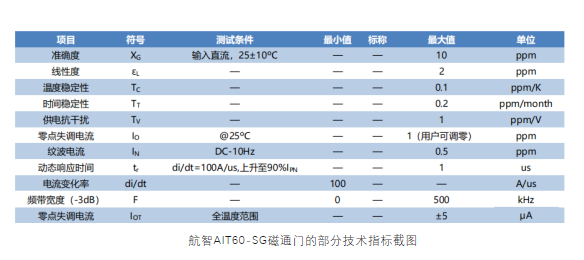
Screenshot of partial technical specifications for the Hangzhi AIT60-SG fluxgate
Applications
Medical magnetic resonance imaging (MRI)
High-precision current or power measurement
Data-center DC power supply system
Shipborne large power supply system
Solar photovoltaic and wind energy storage systems
AC/DC current calibration
Metrology and standards
New energy vehicle energy storage and charging

Fluxgate-related products
The main brands of fluxgate products are Danisense of Denmark and Hangzhi of China.
Danisense is the industry benchmark for fluxgate sensors and a leading global precision current testing solution;

The fluxgate products of Hangzhi Technology, a domestic Chinese high-tech enterprise, adopt patented multi-point zero-flux technology; the company is an emerging strong brand in global high-precision current measurement.
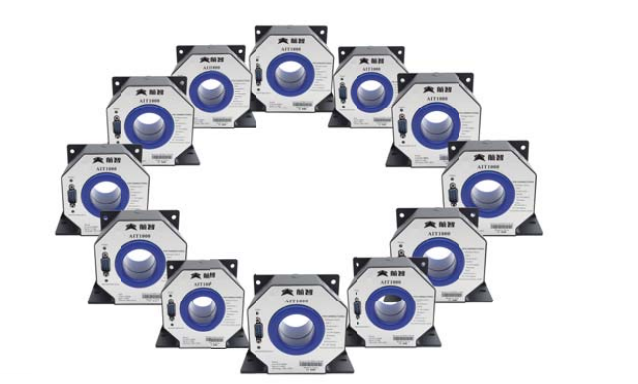
Aerospace patented technology, Chinese solution!

PCIM Europe 2026, Nuremberg: IWATSU and PMK at Booth H7-157
2026-06-15
APEC 2026: 41st IEEE Applied Power Electronics Conference and Exposition
2026-03-15
Semicon China 2026, Shanghai New International Expo Centre (SNIEC)
2026-03-11
WiPDA Asia 2025, Beijing International Convention Center, 15 August
2025-08-06