


Why Coaxial Shunts Cannot Measure High-Side Current Directly
Source: Probemart 2025-11-28 Views: 518

Double-pulse testing is an important means of validating switching device performance in the power-electronics field, and with respect to the accuracy and reliability of current measurement,there areextremely high requirements.
In the double-pulse testing process, the coaxial shunt is undoubtedly an ideal tool for measuring high-frequency current.
However, a coaxial shunt can only directly measure low-side current,and cannot directly test high-side current.
So how can a coaxial shunt be cleverly used to test high-side current?

1. Reasons why a coaxial shunt cannot directly test high-side current
The fundamental reason a coaxial shunt cannot directly measure high-side current is the mismatch between its own characteristics and the operating state of the high-side device; the core contradiction is concentrated in
the conflict between “lack of electrical isolation” and “floating potential of the high-side device,” which then prevents measurement.
A coaxial shunt is essentially a pure resistive structure; it converts current into a voltage signal based on Ohm's law to implement measurement. Its key prerequisite is that the oscilloscope and
the circuit under test must share a common ground—the core function of common grounding is to establish a unified potential reference, ensuring the accuracy of signal acquisition and the safety of the test process,
while avoiding equipment damage. In the half-bridge circuit of double-pulse testing, the high-side device is a “floating device”: the source of the high-side device is connected to the midpoint between the high-side and low-side devices,
its potential is not fixed to ground but switches rapidly with the switching action between “0V” (when the low-side device is on) and the bus voltage (for example, 500V when the high-side device is on),
so it cannot form a stable common-ground relationship with the coaxial shunt, directly resulting in the loss of the measurement reference.
Because the coaxial shunt itself lacks isolation characteristics, if the high-side current is measured directly, the oscilloscope and the circuit under test will not share a common ground,
and a significant potential difference will appear between their grounds, leading to the following situations:
1. Large-current surge: a large-current surge is induced, and the instantaneous large current will burn out the coaxial shunt and the oscilloscope input channel.
2. Electric shock hazard: At this time, the oscilloscope mainframe chassis is grounded through the power cord, and an extremely large potential difference exists between the “ground” of the circuit under test and earth,
willcause the probe ground terminal and the chassis to become live; when test personnel touch them, electric shock is highly likely.
3. Damage to the circuit under test: interferes with normal operation of the switching devices and may even cause driver chip breakdown.
It should be made clear that “common ground” is a basic requirement for the vast majority of non-isolated measurement tools; because the coaxial shunt has no electrical isolation function,
it can only be applied to measurement scenarios involving non-floating devices such as the low-side, and cannot be connected directly to the floating circuit of the high-side.
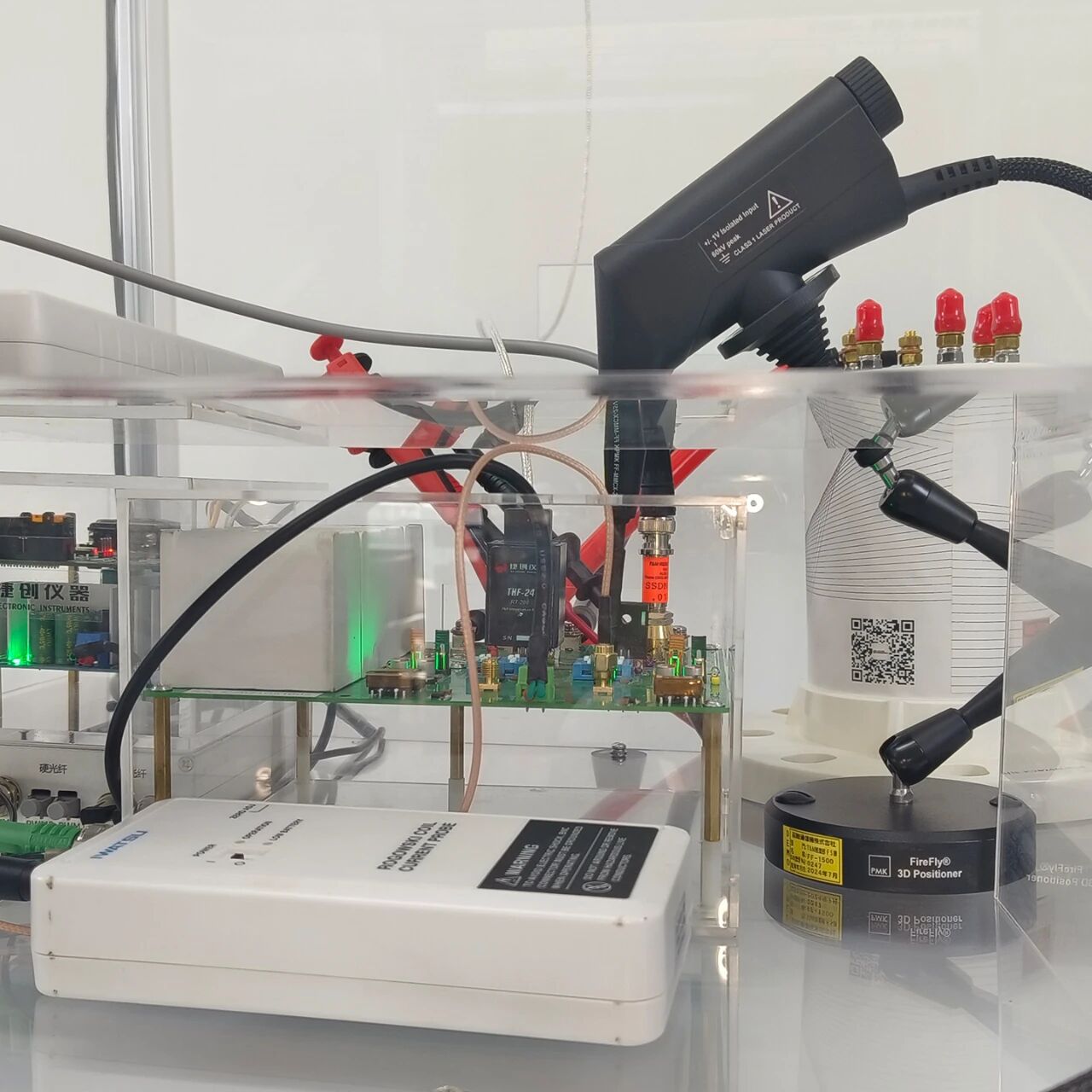
II. Why high-side current measurement is needed In double-pulse testing, low-side current measurement is the industry-standard basic approach,
but high-side current measurement has irreplaceable value in specific scenarios; its necessity stems from the in-depth requirements of the test objectives and the particularity of the scenarios:
1. Supplement the coverage of basic testing The core test objectives of the high-side and low-side are the same—both are to verify switching devices (such as SiC MOSFETs)
switching characteristics (turn-on/turn-off delay, di/dt, peak current), evaluate loop parasitic parameters (on-resistance, parasitic inductance/capacitance),
and provide data for switching loss calculation. However, low-side measurement can only reflect performance in non-floating scenarios, whereas the floating characteristics of the high-side mean that during its switching process
unique parameter variations may occur (such as current fluctuations caused by potential switching); measuring only the low-side cannot fully cover the device operating state.
2. Solve problems specific to floating scenarios The floating characteristics of the high-side make it a “dynamic potential node” in the circuit,
measuring high-side current can specifically solve the following key problems:
a. Verify the true switching characteristics of switching devices under floating conditions and avoid parameter misjudgment caused by non-floating testing;
b. Troubleshoot high-side/low-side current discrepancy issues, such as inconsistent on-state losses between high-side and low-side and asymmetric current spikes;
c. Ensure the reliability of high-voltage high-power circuits; switching problems in floating scenarios are more likely to cause system faults under high-voltage operating conditions,
high-side current data is the key basis for verifying design effectiveness.
3. Support in-depth R&D and troubleshooting In the device parameter optimization stage, it is necessary to compare high-side and low-side current data and adjust gate resistance,
drive voltage, and other key parameters to ensure precise matching of high-side and low-side performance; during troubleshooting, if problems such as excessive current spikes or device overheating occur,
In addition, when the low-side test results are normal, high-side current measurement can quickly locate anomalies in the floating loop (such as excessive parasitic parameters, drive signal distortion, etc.).

III. Comparison of advantages and disadvantages of high-side current measurement solutions
Considering factors such as cost, accuracy requirements, and operational complexity, multiple solutions can be used for high-side current measurement, as shown in the table below.
Recommended solution |
Key advantages |
Limitations |
Application scenarios |
Optically isolated current probe (e.g.,IWATSU) |
Direct measurement, good isolation performance |
Extremely high cost, limited bandwidth (150MHz) |
High-voltage high-power circuits, precise parameter comparison |
Coaxial shunt+Isolated voltage probe |
Reuse of existing coaxial shunt, high flexibility |
Requires frequency-response matching, complex debugging |
Scenarios with an existing coaxial shunt, medium accuracy requirements |
Coaxial shunt+Isolated oscilloscope |
High stability and good accuracy |
High cost; equipment setup and parameter calibration procedures are complex |
R&D testing of high-end power devices |
Based on the above test solutions, users can select according to their own testing requirements. The solution selection recommendations are as follows:
1.If pursuing maximum accuracy and safety with sufficient budget (e.g., high-voltage high-power circuit R&D, core parameter comparison),
Prioritize the optically isolated current probe;
2.If a coaxial shunt is already available and the testing requirement is medium accuracy (e.g., routine floating characteristic verification, basic parameter evaluation),
coaxial shunt + the isolated voltage probe is the most cost-effective solution;
3.If in-depth R&D of high-end devices and complex fault troubleshooting are required, and the requirements for measurement stability and accuracy are extremely high,
the coaxial shunt can be selected + isolated oscilloscope;
4.For routine basic testing (e.g., simple switching characteristic verification, low-cost performance evaluation), only low-side current needs to be measured;
When involving floating scenarios, parameter matching, or high-voltage reliability verification, a high-side current measurement solution must be used.

In summary, if the test objective is to quickly verify routine performance and reduce test cost, only low-side current needs to be measured;
If the test objective is to deeply verify design reliability, fully cover various operating conditions, and troubleshoot complex problems, high-side current must be measured,
and compared with low-side current for analysis. In short, low-side current measurement is the basic guarantee, while high-side current measurement is in-depth optimization.
Select according to your own testing requirements.

PCIM Europe 2026, Nuremberg: IWATSU and PMK at Booth H7-157
2026-06-15
APEC 2026: 41st IEEE Applied Power Electronics Conference and Exposition
2026-03-15
Semicon China 2026, Shanghai New International Expo Centre (SNIEC)
2026-03-11
WiPDA Asia 2025, Beijing International Convention Center, 15 August
2025-08-06